
If your bank has not resolved your complaint within 30 days, you can file a complaint to the Banking Ombudsman by using the RBI Complaint Management System (CMS). In the first place, you must file your complaint at the bank and take note of the complaint number or any other form of evidence of complaint filed.
Then, if you do not get a response within the given time period, or you are not satisfied with the resolution provided, you can file a bank complaint to RBI online through cms.rbi.org.in. After submitting your complaint, you will receive a complaint number that you can use to track your Banking Ombudsman complaint status online.
This guide about banking ombudsman online complaint process and how to track bank complaint status.
What Is the Banking Ombudsman?
The Banking Ombudsman is an officer who is appointed by the Reserve Bank of India to resolve customer grievances of banks and other financial institutions that come under RBI Ombudsman Scheme.
The present scheme known as Reserve Bank – Integrated Ombudsman Scheme, 2026 (RB-IOS 2026) was introduced on July 1, 2026. This scheme substituted the previous one formulated in 2021.
Ombudsman addresses issues regarding deficiency in services. Simply put, it means that either there has been some problem in the service being provided by the bank or any other covered financial institution, or the procedure has not been followed.
RBI Ombudsman is a free of cost service, and you have no requirement of paying any agent or third party organization for lodging your complaint.
Steps to File a Complaint with the Banking Ombudsman
You can file a complaint with the Banking Ombudsman online through the RBI CMS portal. Follow these simple steps:
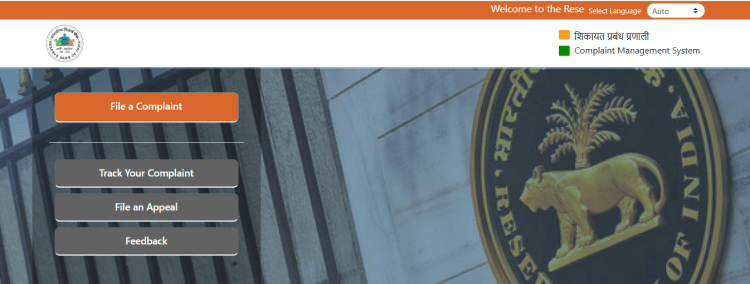
1. Visit cms.rbi.org.in and click to the ‘File a Complaint’ option.
2. Enter your mobile number and complete the OTP verification to continue.
3. Select the type of institution you want to complain about, such as your bank, NBFC, or payment service provider, and then select its name.
4. Enter the details of your complaint. You will need to provide information about the complaint that you already submitted to your bank, including the complaint date and reference number.
5. Explain your problem clearly. Mention what happened, when you contacted the bank, and what response you received. Keep your complaint short and based on the facts.
6. Upload the documents related to your complaint, such as bank statements, transaction details, screenshots, or a copy of your complaint to the bank.
7. Check all the details and submit your complaint. Once the complaint is submitted, save the complaint number. You will need this number to track your Banking Ombudsman complaint status online.
Who Can File a Complaint with the Banking Ombudsman?
Before you file a bank complaint to RBI, make sure these conditions are met:
- Complain to your bank first: File a formal complaint with the bank and note down the reference number.
- Wait for the 30 days: Have to wait for 30 days, if bank did not resolve your issue than only you can file complaint to RBI banking ombudsman.
- Not satisfied with the response: If the bank responded but does not resolve your issue Or you are not satisfied with the response then, you can go for Banking Ombudsman process.
- File within the time limit: Submit your complaint to RBI within the applicable time limit after receiving the bank’s final response.
Why Banking Ombudsman Reject a Complaint
Before you file a bank complaint to RBI, check whether it falls under the RBI Ombudsman rules. The Banking Ombudsman cannot handle every type of complaint, and some complaints may be rejected if they do not meet the required conditions.
- RBI may reject your complaint, if you reach to Banking Ombudsman directly without complaint to the bank first.
- If the same matter is already being heard by a court, consumer forum, tribunal, or arbitrator.
- The Banking Ombudsman cannot usually question a bank’s commercial decisions, such as rejecting a loan application or deciding an interest rate.
- RBI cannot handle complaints about matters that fall outside the types of services and issues covered by the scheme.
- If detailed evidence or required document not provided.
- RBI may reject a complaint if you file it after one year time period of issue occured.
Track Your RBI Banking Ombudsman Complaint Status
After filing a complaint against the bank, you can track the current status of your Banking Ombudsman complaint online through the RBI CMS portal.
To track your complaint click here, enter your complaint number. Then enter the code shown on the screen and click Submit. The portal will show the latest status of your complaint.
Keep your complaint number safe after filing your complaint because you will need it to check the RBI complaint status later.
Appeal Process: If You Disagree with the Ombudsman’s Decision
If you are not satisfied with the Banking Ombudsman’s decision, you still have option to file an appeal. You can appeal if the Ombudsman rejects your complaint or you disagree with the decision.
- File the appeal with the Appellate Authority within 30 days after the decision made by RBI Ombudsman.
- You can submit the appeal through the RBI CMS portal.
- Keep your complaint number, Ombudsman decision, and other related documents ready when filing the appeal.
Frequently Asked Questions
First, raise your complaint with the bank through its branch, customer care, email, or grievance channel. If the bank does not resolve your complaint within 30 days then, you can file a complaint with the Banking Ombudsman via RBI CMS portal.
Visit cms.rbi.org.in and select the option to file a complaint. Enter your details, select your bank, explain your complaint, and upload the relevant documents.
The Banking Ombudsman can handle problems with bank accounts, transactions, cards, digital banking, loans, charges, and other banking services.
After you submit your complaint, RBI checks whether it meets the requirements of the Ombudsman scheme. If RBI takes up the complaint, the concerned bank or financial institution gets an opportunity to respond. The complaint may then be resolved through settlement or through a decision by the Ombudsman, depending on the case.
There is no single fixed time for every RBI bank complaint. The time can depend on the type of complaint.
You need to complain your bank first about an unauthorized transaction. If the bank does not resolve the service related issue, then approach to RBI.