
Every landowner in Odisha has to pay an annual land tax called Khajana to the state government. Earlier, people has to visit the local Tahasil office, standing in queues, and collecting a paper receipt. The Odisha government changed this when it launched e-Pauti, an online land revenue payment system at odishalandrevenue.nic.in.
This guide covers exactly how to pay land revenue payment, how to download your receipt, how to check payment status and what to do if something goes wrong.
What is e-Pauti Odisha?
e-Pauti Odisha is the official online platform for paying land revenue. It was launched on 15 August 2019 by the Revenue & Disaster Management Department and was built and is maintained by the National Informatics Centre (NIC), Bhubaneswar.
The portal is linked to the Bhulekh Odisha land records database (bhulekh.ori.nic.in). Once you make a payment, it gets reflected in your land records automatically.
Before e-Pauti, every landowner farmer, property owner, or legal heir had to visit their Tahasil office once a year. Now the entire process is online, and the digital Pauti receipt you get is legally accepted across all government offices, banks, and courts in Odisha.
What You Need Before You Start
Keep these details ready:
- District, Tahasil, and Village name where your land is located
- Khata number (land account number also called Khatiyan number)
- Depositor’s name and relationship to the recorded tenant (Self / Son / Daughter / Others)
- Mobile number and email ID (for payment confirmation)
- A payment method: Net Banking, Debit/Credit Card, or UPI
Don’t know your Khata number? Visit bhulekh.ori.nic.in, search by name or plot number, your Khata number appears in the Record of Rights (RoR / Khatiyan).
Steps to Pay Land Revenue Online in Odisha
Step 1: Open the portal, go to odishalandrevenue.nic.in and click “Pay Land Revenue” on the homepage.
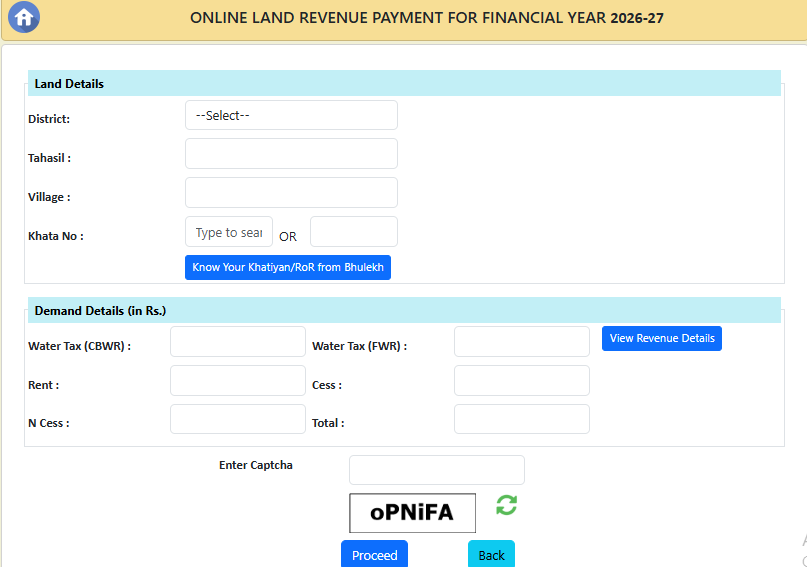
The form heading will show: “Online Land Revenue Payment for Financial Year 2026-27”
Step 2: Enter your land details
Select your District, Tahasil, and Village from the drop-down menus. Then enter your Khata number in the field provided.
The portal will fetch your land record and auto-fill the tenant’s name.
Step 3: Verify your demand details
The Demand Details section shows the exact amounts due:
- Water Tax (CBWR), Water Tax (FWR), Rent, Cess, N Cess, and Total
Check these figures carefully. Enter the Captcha code shown on screen and click Proceed.
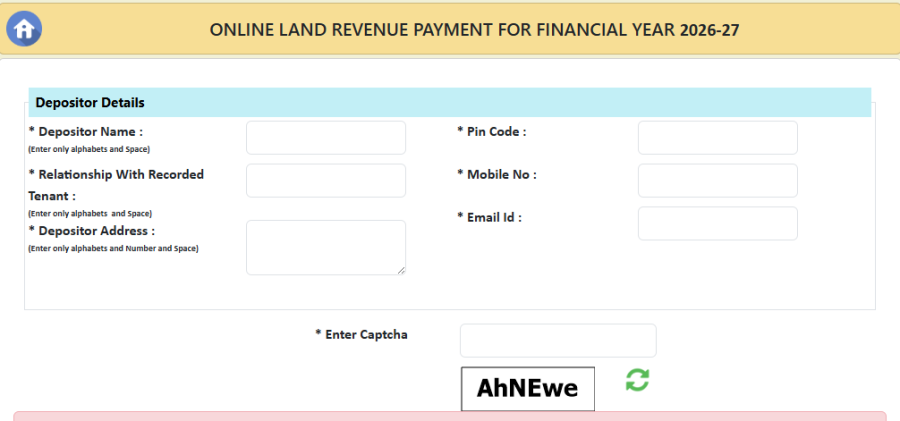
Step 4: Enter depositor information
Fill in:
- Your full name (the person making the payment)
- Your relationship with the recorded tenant: Self / Son / Daughter / Others
- Mobile number and email ID
Click Continue.
Step 5: Accept the Electronic Tenant Ledger terms
A message will appear regarding the Electronic Tenant Ledger. Click Yes to proceed.
Step 6: Confirm challan details
A challan summary page shows your depositor information and the amount. Verify all details here. Click Make Payment.
Step 7: Note the challan reference number
A challan reference number is generated on the payment options page. Save or note this number, you’ll need it if payment confirmation is delayed.
Choose your payment mode (Net Banking / Debit Card / Credit Card / UPI) and complete the payment.
Step 8: Save your acknowledgment slip
After successful payment, an acknowledgment slip is generated on screen. Download or print it immediately. The slip contains your transaction reference, keep it safe.
Read our guide to check: Rural Housing Odisha Beneficiary List
How to Check Payment Status and Download Pauti Receipt
Once payment is done, here is how to get your official Pauti (rent receipt):
- Go to odishalandrevenue.nic.in
- Click “Know Payment Status & Download Receipt”
- Select the Financial Year (e.g., 2026-27)
- Choose your District, Tahasil, and Village
- Enter your Khata number
- The portal shows your transaction status and receipt download option
What Does Your Land Revenue Bill Include?
When you open the payment form on e-Pauti and enter your Khata details, the portal shows a Demand Details section. Here’s what each line means:
- Rent – The basic annual land tax payable to the state government. For most small agricultural or residential plots, this is a very small amount, sometimes just a few rupees per year.
- Cess – An additional levy collected on top of Rent, under the Orissa Cess Act, 1962. It is calculated as a percentage of the basic Rent. If unpaid for multiple years, it shows as arrears.
- N Cess (Nistar Cess) – A small levy related to the use of government forest produce and common land resources by village communities. May appear as arrears if not paid for several years.
- Water Tax (CBWR / FWR) – Water-related charges applicable to certain land types. Not every plot has this, it depends on your land category and district.
- Total – The final amount you need to pay, including any arrears from previous years.
Important: Pay attention to arrears. If you have missed payments from previous years, those get added to your current bill automatically. The portal shows the total due, always verify this before proceeding.
What If Money Was Deducted But Receipt Didn’t Come?
This happens occasionally, especially during the start of a new financial year when the portal updates for that year’s calculations.
Do this:
- Don’t panic. Do not attempt payment again.
- Go to “Know Payment Status & Download Receipt” and check your status using District + Tahasil + Village + Khata number.
- If it shows P (Pending), wait 24 – 48 hours and check again, most pending transactions resolve automatically.
- If it shows F (Failed), your money will be refunded to your original payment source within 5–7 working days (refund timelines depend on your bank or UPI provider).
- Save your bank transaction reference number as proof. This is different from the e-Pauti challan number.
- If the issue persists, contact NIC Bhubaneswar or raise a grievance through the Revenue & Disaster Management Department, Odisha’s official portal.
FAQs:
You need to make a separate payment transaction for each Khata number on the e-Pauti portal.
Visit bhulekh.ori.nic.in and search using your name or village.
The portal accepts Net Banking, Debit Card, Credit Card, and UPI
Yes. NRIs can access the portal online from anywhere.